The UEFA LED specification The part of the UEFA spec that is a software problem.
UEFA publishes a technical specification for LED pitch perimeter boards, and most of it is about cabinets, cabling and power. A few lines in it are about the software that drives the wall, and those are the lines a club buying playout software has to answer. Here they are, quoted, with what each one means in the control room on a match night.
In one competition your software runs the match. In the other it does not.
This is the thing clubs discover late, and it changes what you are buying. In the Champions League, UEFA appoints its own LED supplier, and the specification says that supplier needs access to the system to implement their software control for artwork management, run sequence preparation, on-site graphics control, and match operation and reporting. Your technicians work under their supervisor and control operator. Your playout software is not driving that match.
In the Europa League, the Conference League and the Women’s Champions League, the document is explicit that there is no external overlay supplier, that the club’s own play-out system should be used by the club’s usual LED operator, and that UEFA sends a supervisor to help with its partner and corporate messages. Your software runs the match, with somebody from UEFA standing next to the operator.
So when a vendor says "UEFA compliant", the useful question is which competition they mean. For a club in the Europa League or the Conference League, the software choice is a European-night choice. For a club in the Champions League, the system has to satisfy a supplier who will arrive with their own.
What it asks, what it means, where we sit.
From the content control and data interfacing section, plus the two power lines that decide whether any of it survives. The left column is the specification’s own wording. Required for the Champions League and club competition finals; preferred or optional in the other competitions, except where noted.
| The specification says | What that means in the control room | USM Boarding |
|---|---|---|
| "System viewed and operated as one single screen by control software." | A perimeter built from many cabinets on several processors has to behave as one continuous picture, with no sections for an operator to line up by hand. Required in every competition, not just the Champions League. | A screen in USM is the wall, at its real pixel geometry, however many cabinets and processors are behind it. Content is laid onto that one surface. |
| "Dual signal servers, each on UPS." | Two playout machines, each on its own uninterruptible supply, so a power event takes neither the picture nor the machine that makes it. | The main and backup PCs are exactly this pair. USM mirrors the project and the running state between them and the backup takes the wall by itself after about five seconds of silence. |
| "System back to full spec control after pitch power loss in < 25 sec." | After the pitch-side power comes back, everything has to be under control again inside twenty-five seconds. Under control, which is more than switched on. | Whether this is met is a rack question as much as a software one. A backup PC on a UPS never lost control, which is how the twenty-five seconds is usually kept. Ask us to look at your setup. |
| "Default graphics (auto-switch feature) installed and enabled (set to static shared-rotation) in case of total data connection loss with server." | If the wall loses the playout machine entirely, it must not go black or freeze on whatever was there: the processors show a stored default instead. | This one lives in the LED system and its processors. We can read whether yours is configured for it, because we read those processors already. |
| "Individual control of brightness, gamma, colours of every single pixel/module/cabinet." | A wall built in phases, or repaired with newer cabinets, has to be evened out. Required for the Champions League, optional elsewhere. | Per-cabinet calibration belongs to the LED system and NovaLCT. USM applies colour correction to content per screen, which is a different and complementary thing. |
| "Control signal connection via two redundant feeding points" and "Data ring loop configured; if one connection fails an automatic switch activates data source from the opposite section." | The data reaches the wall from both ends, so a cut cable loses nothing: the loop feeds the orphaned section from the other side. | Cabling and processor configuration. Worth knowing that our monitoring reports when a section has fallen back to its backup line, which is when you want to know it. |
| "Remote data monitoring and analysis." | Being able to see the state of the wall without standing next to it. Listed as optional in every competition, which is why almost nobody offers it. | This is the thing we built. Cabinet by cabinet, temperature, main and backup line, the input signal, from anywhere, with thirteen months of history. |
| "Fully backed-up power / two independent power sources preferred." | Preferred rather than required, and the difference between a fixture that survives a power event and one that does not. | Not ours to supply. It is the single thing we would spend money on first, ahead of any software. |
The numbers people ask us about, which are not software.
Clubs ask us these constantly because we are in the room, so here they are. The left of each pair is the Champions League and club competition finals, the right is the Europa League, the Conference League and the Women’s Champions League.
- Pixel pitch
- 12.5 mm or less, 3-in-1 SMD · 16 mm or less, 3-in-1 SMD
- Length
- At least 246 m with closed corners · touchline and goalline to near the 6 m line, open corners allowed
- Display height
- At least 90 cm · at least 80 cm
- Refresh rate
- At least 2,800 Hz · at least 1,800 Hz
- Stills test
- Photography clearly visible at 1/2000 exposure at 10% brightness (Champions League)
- Luminance
- At least 5,500 nit, ideally 6,000 (Champions League)
- Viewing angle
- Horizontal at least 140°, ideally 160° · vertical at least 60°
- Spares on site
- At least two spare cabinets, modules hot-swappable in under a minute
- Technicians
- Two LED technicians from midday MD-2 to midday MD+1 (Champions League)
EUR 25,000 per match.
If a club cannot provide a system meeting the specification, the document says UEFA will provide and install one, and will deduct EUR 25,000 per match for it from the distribution due to the club. Removing the non-compliant system is the club’s responsibility and cost.
Which is why "is our system compliant" is a finance question as much as a technical one, and why it is worth having the answer in writing before a European draw. UEFA surveys and approves systems on site, and the document names its consultant agency for those reviews.
None of this makes software the expensive part. It makes the software the part that has to not be the reason the survey fails.
For what it is worth: 5 of the 6 grounds USM runs at have UEFA-approved LED systems. Those approvals are of the installations, as the document says they must be, and not of any software including ours. What it does mean is that our playout has been in rooms where that survey was passed.
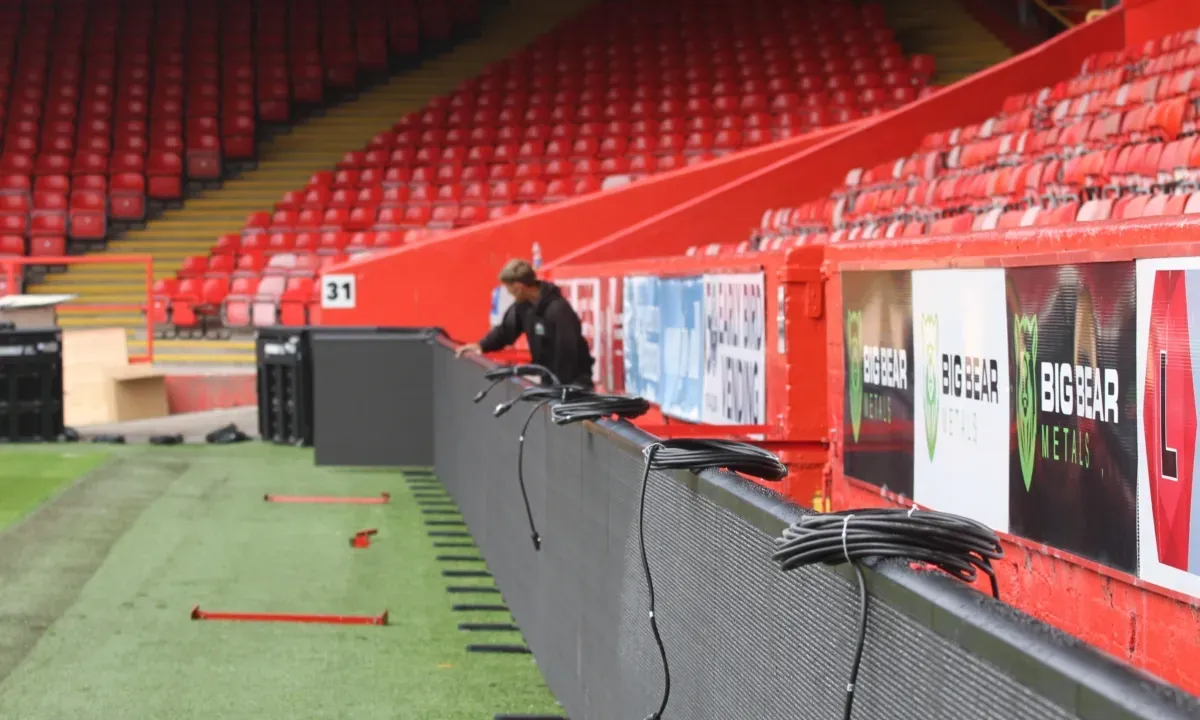
Pittodrie, in the photograph at the top, is one of those grounds. How its 246-metre wall runs.
Playing in Europe this season?
Send us what is in your rack and which competition you are in. We will tell you which lines of the specification your setup already answers, which are cabling or power rather than software, and where we would put the next euro.