Football LED software
The match-day timeline.
Warm-up, line-ups, kick-off, the rotations, added time, half-time. What the software has to do at each point, and what goes wrong when it cannot.
Match day, step by stepLED boarding software drives the advertising boards around a pitch: the perimeter run, the fascia above the stand, the ribbon under the upper tier. This is what that job actually involves, what separates one product from another, and how USM Boarding does it.
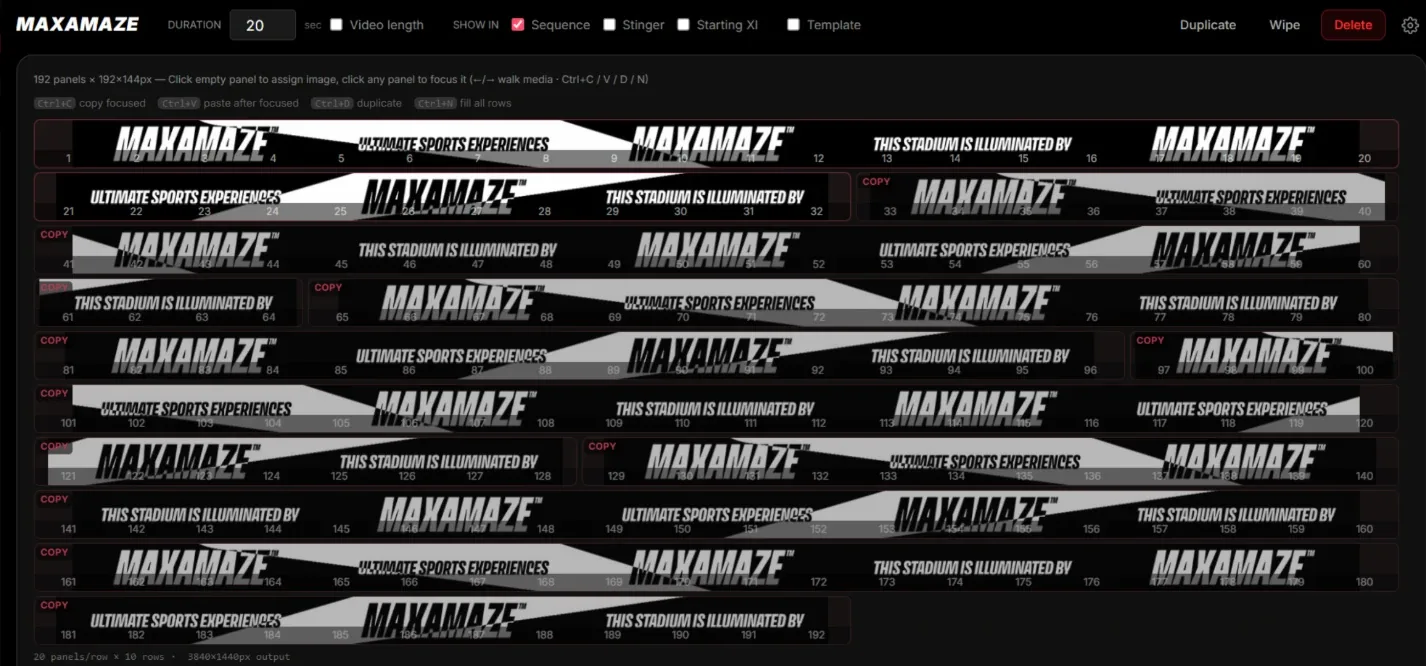
An LED perimeter is a long, thin, physically awkward surface, often 19584 pixels wide and 144 high, built from cabinets that were installed by different people in different years and do not all have the same pixel pitch. Artwork arrives from a sponsor agency at whatever size that agency felt like exporting. Something has to get one onto the other, at the right moment, without anybody in the stand seeing the seam.
Two of ours: Pittodrie’s run mixes three panel sizes to fit thirteen access gates, and Lotto Park’s two ribbons, at P6 and P12, change on the same frame.
The job splits into four: lay the artwork onto the wall, queue it, fire it at the right second, and afterwards prove it ran. A product can be excellent at one of those and poor at the next, which is why demonstrations look alike and match days do not.
The fifth thing, the one nobody asks about until it happens, is what the system does when the playout PC dies in the second half with a sponsor contract still running.
On a projector in a meeting room the dozen or so products that do this job look alike. The differences show on a match night, and the way to see them early is to make a vendor prove six things on your own wall with your own artwork. The six questions are on the choosing page, with the reason each one matters.
Two of them do most of the work. Hand over the worst sponsor file you have, a JPEG at the wrong aspect ratio for a run whose cabinets are not all the same pitch, and count the clicks until it looks right. Then pull the network cable out of the main PC in the middle of the demo and watch whether anybody has to decide anything.
The model is deliberately small. An operator who understands these four can run a fixture, and there is nothing else to learn before they can.
The artwork as the agency delivered it. A picture or a video file, imported once.
That artwork laid onto the wall: scaled, cropped, spanned across panels, saved and reusable next week.
A queue of sequences for one screen. The rundown the operator watches during the match.
Which playlist runs on which wall. One key press coordinates several screens at once, in sync, on a single frame.
The trade has never agreed on a word. In Belgium and the Netherlands it is boarding. In Germany it is Bandenwerbung and the software is Bandensoftware. In the United Kingdom it is often hoardings or perimeter advertising, in the United States ribbon boards and fascia. Agencies say banners; broadcast says the perimeter. The people who build the software sell it as perimeter advertising software, perimeter digital signage software, stadium LED playout and LED content management for live events, and the hardware makers call the whole thing a digital perimeter.
They all describe the same surface, and the software problem is identical in each: a long strip of LED, sponsor artwork that does not fit it, and a rotation that has to hit its second. If you arrived here searching for one of those words, this page is about the thing you meant, and the LED guides explain the board itself.
What differs by market is the contract behind it. UEFA fixtures bring their own rules about redundancy and about what may appear. Domestic leagues bring their own about how long each sponsor holds the wall. Both come back to the same two capabilities: a backup that genuinely takes over, and a log a rights holder will accept.
The match-day timeline.
Warm-up, line-ups, kick-off, the rotations, added time, half-time. What the software has to do at each point, and what goes wrong when it cannot.
Match day, step by stepWhat the sponsor is owed.
Every banner that reached the wall, to a hundredth of a second, exported as a report an agency can audit.
How the log worksIs it us or the wall?
USM reads the NovaStar processors behind the boards, so when part of the perimeter goes dark you know within seconds which side of the DVI cable the fault is on.
See LED monitoringThey all demo well.
The six questions that separate perimeter advertising software on a match night, what to make a vendor prove on your own wall, and where we are the wrong answer.
How to chooseSend us the geometry of your perimeter and a sponsor file that has given you trouble, and you will get back the sequence as USM fitted it, with what it took.