Football LED software Ninety minutes, and none of them wait for the software.
A football match is a fixed timeline with an unpredictable clock. The perimeter has to follow it: sponsors rotating on contract, a goal that arrives mid-rotation, added time nobody knew about until the fourth official raised the board. This is what USM Boarding does at each point of a fixture.
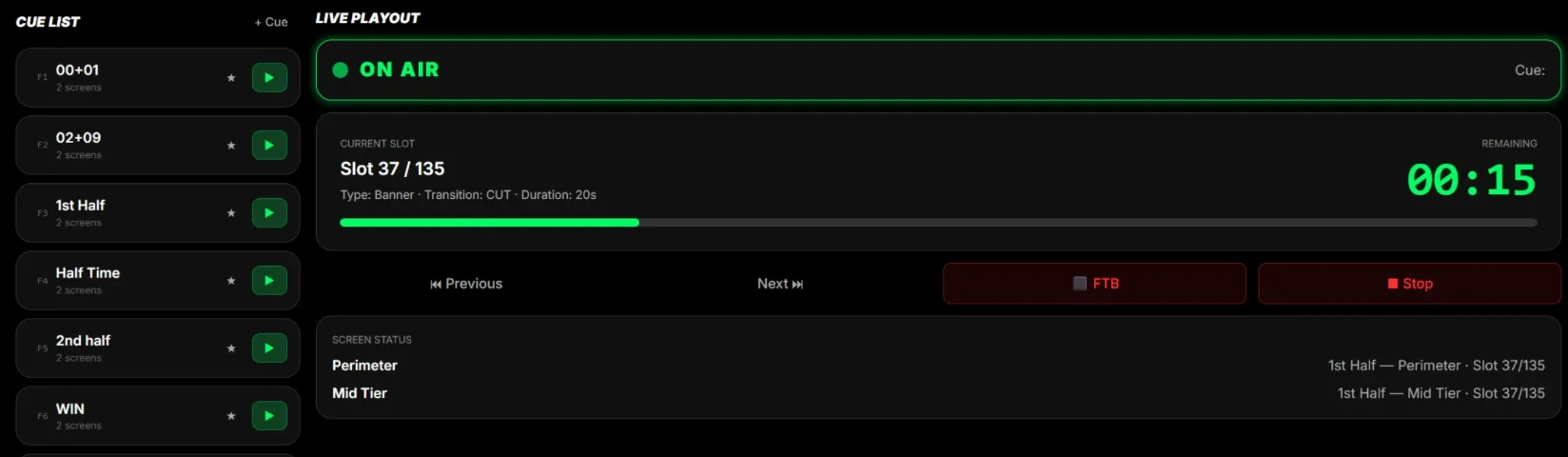
From the empty stadium to the final whistle.
The rundown is built in advance and changed until the last minute, which is the part most software makes hard.
Two hours before, in the office
The marketing department builds the fixture in a browser: this week’s sponsor set, the new club campaign, the charity board the chairman added this morning. The venue PC picks it up. Nobody has to drive to the stadium to change a banner.
Warm-up
A loop runs while the ground fills. It is a playlist like any other, so swapping it for the cup-night version is one cue.
Line-ups
Player names and numbers come off the team sheet and onto the wall. Starting Eleven reveals them one by one on the perimeter, with a stinger between each.
Kick-off
The rotation starts. Each sponsor holds the wall for its contracted seconds and hands over on a single frame, with no black and no tear between sequences.
A goal, mid-rotation
The operator fires the goal graphic over whatever is playing, and the rotation resumes where it was. The sponsor that was interrupted is still owed its seconds, and the log knows it.
Added time
Four minutes appear that the rundown did not plan for. The playlist keeps rotating, the operator extends or cuts from the same screen, and nothing has to be rebuilt to fill them.
Half-time and full-time
One cue moves every screen in the ground to the half-time set at once. Afterwards the fixture exports as a report: what ran, when, for how long, on which wall.
The four calls we get.
These are the reasons clubs change software, in the order we hear them.
- The PC died and the wall went black. A backup PC mirrors the main one through the match and takes the wall after about five seconds of silence. The stand sees a frame, the sponsor sees nothing.
- Half the perimeter is dark and nobody knows whose fault it is. LED monitoring reads the processors behind the boards: which cabinets stopped answering, which cable failed, whether our signal is still arriving. Two minutes of argument becomes one line on a page.
- The sponsor says their banner did not run. The log says otherwise, to a hundredth of a second, per screen, exportable to the file their agency asked for.
- It takes an hour to prepare a fixture. Sequences are reusable, playlists are copied from last week, and the whole project is edited online. A routine fixture takes minutes.
Everything else the wall has to carry.
- Fascia and ribbon
- Any geometry the wall actually is, including 2100 x 120 and 10460 x 120
- Several screens, one press
- Up to nine screens on one licence, cued together and in sync
- Scoreboard and live text
- Score, clock and names from the timing system or typed in, straight onto the boards
- NDI out
- The same content to a broadcast or streaming chain without a second render
- Stingers and overlays
- A goal, a substitution or a sponsor moment fired over a running rotation
- Companion
- Stream Deck buttons for the cues an operator uses every week
- API triggers
- Fire a cue from the scoreboard system, a timing feed or a control-room button
The same wall, a different clock.
Basketball and handball arenas run the same product with a faster rotation and a shorter clock. Equestrian venues run it against live results from the ring, where the rider on the board has to be the rider currently jumping, and the board has to clear the moment they leave.
If your sport has a scoreboard, a sponsor contract and a wall, the model is the same: media, sequence, playlist, cue. What changes is what fires the cue.
Run a fixture with us watching.
Tell us your league, the shape of your perimeter and what went wrong at the last home game. If it is one of the four calls above, the fix is on this page. If it is something else, we want to hear it.