Proof of play for LED advertising What ran, when, for how long, on which wall.
A sponsor pays for seconds on the perimeter. Proving they got them is the difference between an invoice that is paid and an argument in March about a Tuesday in October. USM logs every banner that reached the wall to a hundredth of a second, and exports the fixture as a file an agency can audit.
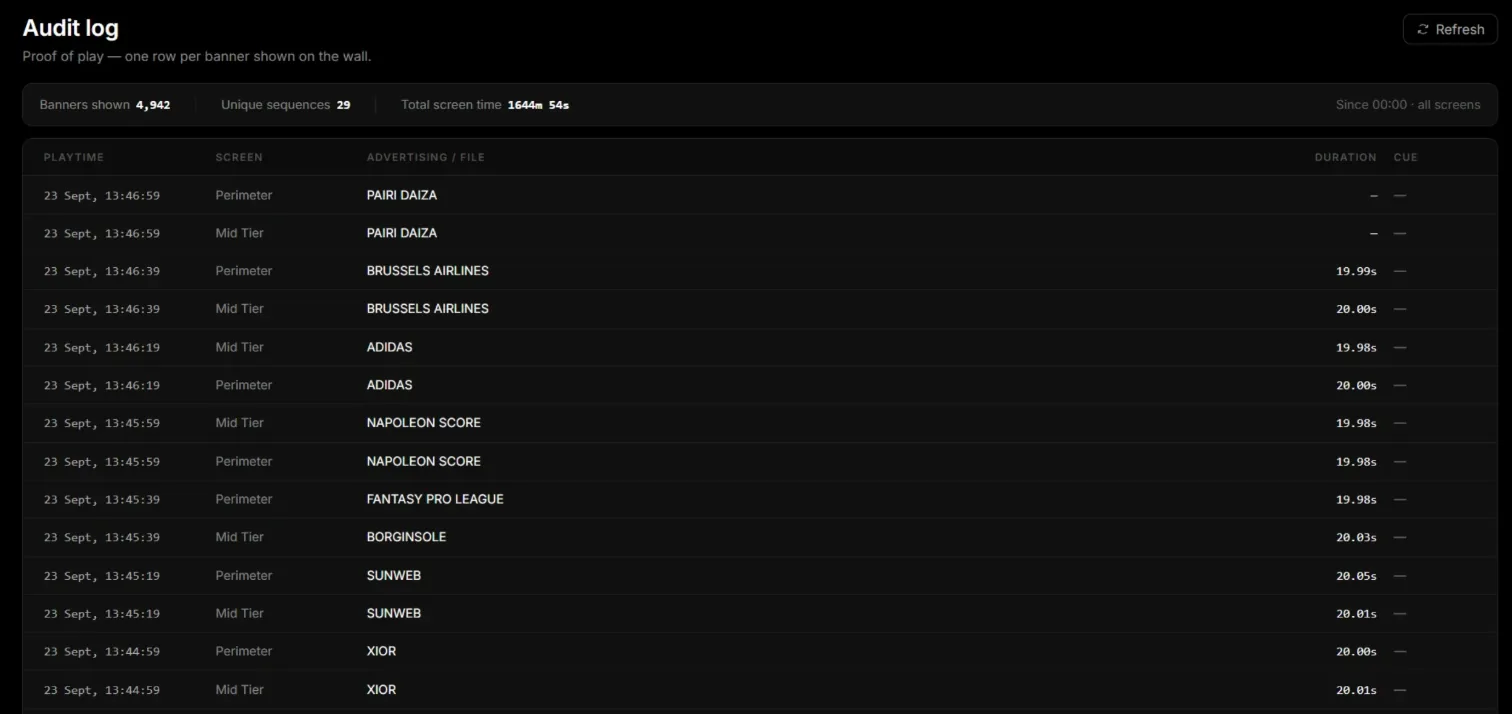
A screenshot is not evidence.
Most perimeter reporting is a rundown: the list of what was meant to run. It is written before the match and it does not know about the goal that interrupted a rotation, the screen that went dark for ninety seconds, or the operator who cut a sponsor short because the half ended early.
What a rights holder is actually asking is what reached the wall. That can only be recorded by the thing that put it there, at the moment it did, and it has to survive the match ending, the PC restarting and the operator going home.
Written as it happens.
- Every scheduled play. Which sequence, on which screen, from when to when, at a hundredth of a second.
- The interruptions. A stinger over a rotation, a cue that moved the wall, a slot that was cut short. The log keeps what actually happened, not the plan.
- Which wall. Per screen, so a fixture with a perimeter, a fascia and a ribbon reports three surfaces, each on its own line.
- The gaps. A screen that was not airable, a machine that was off, a playout that stopped. A report that hides its holes is worth nothing when it is challenged.
Three clicks after the final whistle.
Pick the fixture
The audit log lists the sessions. Choose the match, or a date range across a season.
Choose the shape
PDF for the sponsor, Excel for the agency that wants to pivot it against their media plan.
Send it
One file per fixture, per screen or per sponsor, with the machine and the project it came from named on it.
What a technical buyer will want to check.
- Resolution
- a hundredth of a second
- Written by
- the playout engine itself, at the moment content reaches the wall
- Granularity
- per screen, per sequence, per play
- Formats
- PDF and Excel, per fixture or per period
- Kept
- with the project, and mirrored to the cloud so a lost PC is not a lost season
- Multi-screen
- a proof-of-play export can cover several screens in one document
A log proves it was sent. Monitoring proves it arrived.
The playout log records what left the software. It cannot tell you that a row of cabinets was dark at the time, because it is on the wrong side of the DVI cable to know.
That is what LED monitoring is for: it reads the processors behind the boards, records which cabinets were answering and which were not, and keeps thirteen months of it. A fixture with both is a fixture where the software can show what it sent and the wall can show what it displayed.
Send us the report your sponsor rejected.
We will rebuild the same fixture as USM would have logged it, so you can put the two side by side and see which one answers the question they were asking.